
glotter is a Typst package for detecting the language of text fragments and applying language-aware settings to content.
The Typst plugin is compiled to WebAssembly using fasttext-pure-rs, a pure Rust implementation of fastText.
Usage
#import "@preview/glotter:0.1.0": *

#let samples = (
  ja: "これは日本語の文章です。",
  en: "This is an English sentence.",
)

#let print-lang(text) = [
  #text $arrow$ #lang(text) \
]

#print-lang(samples.ja)
#print-lang(samples.en)
To retrieve detailed prediction metadata, use detect-info:
#let info = detect-info(
  samples.en,
  k: 3,
  min-margin: 0.12,
)

#let print-info(info) = [
  Language: #info.at("lang") \
  Probability: #info.at("probability") \
  Ambiguous: #info.at("ambiguous")
]

#print-info(info)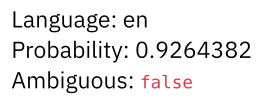
To apply the detected language automatically to content:
Typst can apply language-specific text settings when the language is known, but the language must normally be specified manually. auto-text detects the language of a fragment and applies the corresponding text(lang: ...) setting automatically.
#let sample = "שלום עולם"

*Plain text:*

#sample

*Manual Typst:*

#text(lang: "he")[#sample]

*With glotter:*

#auto-text[#sample]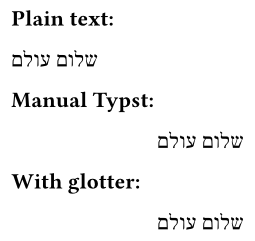
For document-wide use, auto-par can be installed as a paragraph show rule. Each paragraph is detected independently, so mixed-language documents can be written without wrapping every paragraph in text(lang: ...).
#show par: it => auto-par(it, fallback: "en")

Hello world.

Hallo Welt.

שלום עולם.

مرحبا بالعالم.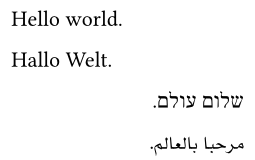
Use Cases
glotter can be used directly, but it is also designed as a building block for downstream Typst packages, templates, and document-processing workflows.
Typst already supports language-aware text through text(lang: ...). glotter provides the missing step: detecting which language should be applied to a given text fragment.
Multilingual templates
Templates can use glotter to accept multilingual content without requiring users to annotate every fragment manually.
#let localized-abstract(body) = {
  let info = detect-info(body, fallback: "en")
  let l = info.at("lang")
  let rtl-lang = ("ar", "fa", "he", "ur").contains(l)

  let title = if l == "ja" {
    "概要"
  } else if l == "ar" {
    "ملخص"
  } else if l == "de" {
    "Zusammenfassung"
  } else if l == "fr" {
    "Résumé"
  } else {
    "Abstract"
  }

  block(
    width: 10cm,
    inset: 8pt,
    stroke: 0.5pt + luma(180),
    radius: 4pt,
  )[
    #set text(lang: l, dir: if rtl-lang { rtl } else { ltr })
    #set align(if rtl-lang { right } else { left })

    #strong[#title] \
    #auto-text(fallback: "en")[#body]
  ]
}

#localized-abstract[This package detects the language of text fragments.]

#localized-abstract[تقوم هذه الحزمة بتحديد لغة أجزاء النص.]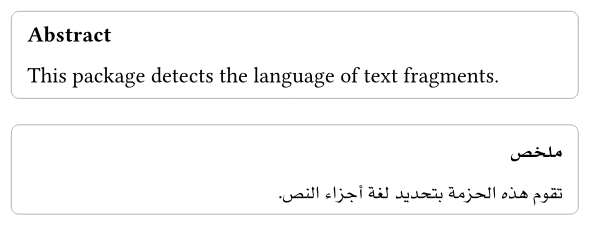
Language-dependent rendering
Downstream packages can use detect-info to branch on the detected language.
#import "@preview/note-me:0.6.0": *

#let localized-note(body) = {
  let info = detect-info(body, fallback: "en")
  let l = info.at("lang")

  let title = if l == "ja" {
    "注意"
  } else if l == "de" {
    "Hinweis"
  } else if l == "fr" {
    "Remarque"
  } else {
    "Note"
  }

  note(title: title)[
    #auto-text(fallback: "en")[#body]
  ]
}

#localized-note[This is an English note.]

#localized-note[これは日本語の注記です。]

#localized-note[Dies ist ein deutscher Hinweis.]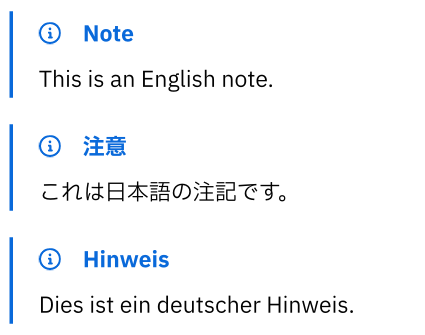
API
detect(input, k: 1, threshold: 0.0): returns raw predictions as dictionaries withlang,label, andprobability.detect-info(input, k: 3, threshold: 0.0, min-margin: 0.12, fallback: "und"): returns a dictionary containing the final language, top prediction, all predictions, probability margin, ambiguity flag, fallback value, and normalized input.lang(input, ...): returns a language code.is-lang(input, expected, ...): checks whether the detected language matches a given string or any string in an array.is-cjk(input, ...),is-rtl(input, ...),is-latin(input, ...): convenience script-family checks.auto-text(body, fallback: "en", debug: false, ...): detects the language ofbodyand wraps it intext(lang: detected-language); any additional named arguments are forwarded totext(...).auto-par(it, fallback: "en"): detects a paragraph and applies the detected language; intended for use with#show par.debug-info(info): renders a compact diagnostic label for adetect-inforesult.supported-languages: array of the 176 language codes supported by the embedded fastText language identification model.supported-language-count: number of language codes supported by the embedded fastText language identification model.is-supported-language(language): checks whether a language code or fastText label is supported.
The embedded model expects UTF-8 text.
fastText Model Provenance
package/glotter.wasm embeds data from the fastText language identification model lid.176.ftz, the compressed variant of fastText’s 176-language identification model.
Official source: https://fasttext.cc/docs/en/language-identification.html
The official fastText documentation states that the language identification models were trained on data from Wikipedia, Tatoeba, and SETimes, and are distributed under CC-BY-SA-3.0.
License
glotter is distributed under MIT AND CC-BY-SA-3.0.
This package does not include the standalone fastText model file lid.176.ftz. However, this package includes package/glotter.wasm, which embeds model data from lid.176.ftz. For that reason, the package contains material under both:
- MIT License for the Typst package and plugin code.
- Creative Commons Attribution-ShareAlike 3.0 Unported for the embedded fastText model data.
The package code is MIT licensed. The embedded fastText model data in glotter.wasm is licensed under CC-BY-SA-3.0. See NOTICE.md for attribution, checksums, modification status, and redistribution notes. License texts are provided in LICENSE-MIT and LICENSE-CC-BY-SA-3.0.